

MEDIA & PUBLICATIONS
INTA Emergency Task Force Drives Key Changes to Brazilian High-Renown Trademark Guidelines

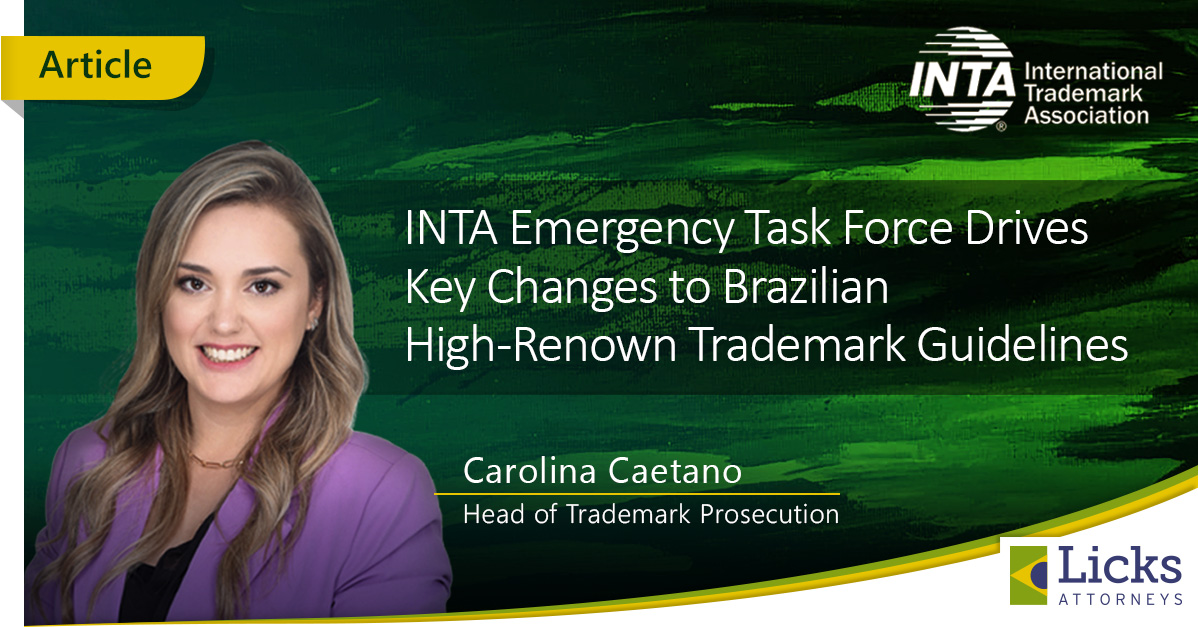
On August 7, 2025, the Brazilian Patent and Trademark Office (BPTO) released a significant update to its Trademark Manual, introducing detailed guidelines for the recognition of high-renown status of trademarks in Brazil. This milestone followed a public consultation held from April 8 to May 19, 2025, which saw active engagement from stakeholders—including a coordinated and strategic response from INTA.
Recognizing the urgency and potential impact of the proposed changes, INTA swiftly mobilized an emergency task force that brought together members from the Famous and Well-Known Marks Committee, the Trademark Office Practices Committee, and the Non-Traditional Marks Committee to ensure a comprehensive and technically sound response. INTA members involved in the proposal by committees were:
- Famous and Well-Known Marks Committee: Carolina Caetano (Licks Attorneys, Brazil), Clarice Minatogawa (Magalhães Nogueira Sociedade de Advogados, Brazil), Clarissa Jaegger (Montaury Pimenta, Brazil), Daniel Adensohn Souza (Ricci Propriedade Intelectual, Brazil), and Suzana Lemos (Luiz Leonardos Advogados, Brazil);
- Trademark Office Practices Committee: Pedro Tavares (Barbosa Müssnich Aragão (BMA)), Brazil); and
- Non-Traditional Marks Committee: Paula Bezerra de Menezes (Dantas Ruiz Advogados, Brazil).
This cross-committee collaboration enabled INTA to submit a unified and well-supported set of recommendations to the BPTO.
The task force’s efforts resulted in four contributions being fully accepted and six partially accepted, reflecting the BPTO’s openness to stakeholder input. The accepted suggestions addressed key aspects of survey methodology and evidentiary standards, including:
- Sampling recruitment: INTA’s recommendation to clarify inappropriate media channels for survey recruitment was incorporated.
- Online surveys for virtual brands: The BPTO removed restrictions on online surveys for virtual brands, aligning with INTA’s position.
- Survey representativeness: INTA’s proposed terminology changes and allowance for clarification requests were adopted.
- Perception questions: The BPTO revised its guidelines to ensure that questions on brand reputation are asked only to respondents who correctly identify the brand.
Among the partially accepted contributions, INTA achieved meaningful progress in these areas:
- Making market research recommended rather than mandatory, while establishing defined minimum parameters;
- Permitting additional types of supporting documents;
- Allowing non-binding pre-consultations with the High Renown Commission for survey design;
- Reducing the recognition threshold from 71 percent to 61 percent, with additional evidence required for borderline cases; and
- Clarifying the use of demographic data sources for sample representativeness.
While some proposals were not accepted, such as eliminating the recognition threshold entirely or reducing sample size requirements, the BPTO did adjust its stance in certain areas, demonstrating a willingness to compromise and modernize its approach.
This outcome represents a success case for INTA’s advocacy in Brazil, showcasing how rapid mobilization and inter-committee collaboration can lead to tangible regulatory improvements. The BPTO’s final guidelines now reflect a more balanced and flexible framework for proving high-renown status, while maintaining rigorous standards.
For applicants seeking recognition of a high-renown trademark, the updated guidelines specify that evidence must include nationwide market and brand image research, supported by additional documentation. The research must be:
- Quantitative and objective, covering brand awareness, association with goods/services, and public perception of quality and prestige;
- Conducted without bias and prior to any other brand-related surveys;
- Nationwide, with a representative sample of at least 2,000 respondents across Brazil’s five regions;
- Statistically robust, with a minimum 95 percent confidence level;
- No older than two years at the time of submission; and
- Conducted via in-person, online, or phone methods (note: phone surveys are only valid for word marks).
The sample must proportionally reflect Brazil’s population in terms of geography, gender, age, education, and economic class. To meet the recognition threshold, at least 61 percent of respondents must identify the trademark, with additional evidence required if recognition falls between 61 percent and 71 percent.
INTA’s proactive engagement and the BPTO’s responsiveness mark a pivotal moment for trademark protection in Brazil. This achievement highlights the value of coordinated committee action and reinforces INTA’s role in shaping trademark policy in Brazil.

RECENT PUBLICATIONS

LINKEDIN FEED

ソーシャルメディアでフォローしてください