

MEDIA & PUBLICATIONS
SEPs and War in the Courts: How Anti-Suit Injunctions and Interim Licenses Influenced Global Litigation in 2025

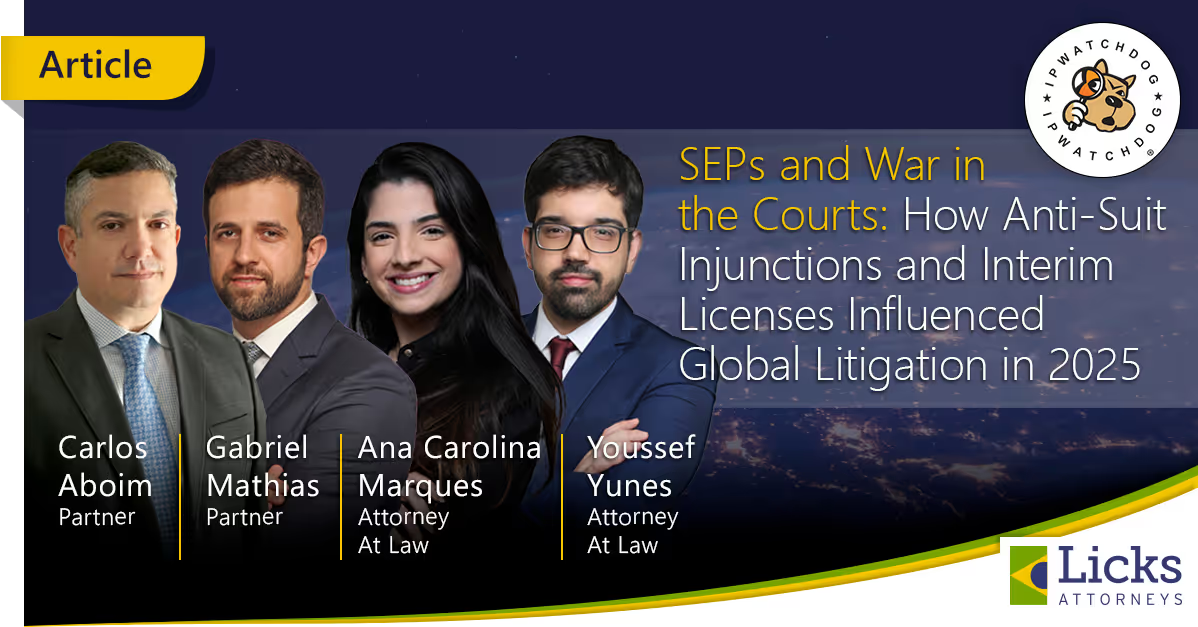
“[There is a] structural tension between patent territoriality and the reality of technologies that operate on a global scale. What has changed in 2025 is the willingness of certain courts to resolve this tension unilaterally, arrogating jurisdiction to set global royalties for SEPs.”
Global litigation over standard essential patents is facing new strategies by implementers, mainly related to venue selection. There is an increasing risk of foreign decisions aimed at interfering with decisions on infringement of patents granted and issued in foreign jurisdictions – in clear tension with the territoriality principle. There is also a trend of abuse of process in the selection of venues within specific countries aimed at creating obstacles and delaying remedies and effective protection for national IP rights.
This behavior by implementers is consistent with what can be seen in negotiations that take place prior to the filing of a lawsuit. The actual experience of litigating essential and non-essential patents for more than a decade shows that implementers rarely bring evidence of patent “hold up”. Innovators, meanwhile, suffer irreparable harm due to the inability to keep investing in new cycles of innovation and also irreparable damage to their licensing programs whenever any company is competing with licensees without a license.
The fair, reasonable and non-discriminatory (FRAND) commitment is often misrepresented as an automatic license, or even as a “royalty-free” license, that is an obstacle for any type of interim relief. Implementers claim that offers are abusive, but seldom present arguments, let alone evidence, about the alleged abuse. It is convenient for big companies to just wait for a lawsuit to play out while continuing to use the technologies without paying.
Implementers seek Anti-Suit Injunctions (ASIs) and Interim Licenses in forums considered favorable, attempting to neutralize infringement actions in other jurisdictions. Holders respond with Anti-Anti-Suit Injunctions (AASIs) and, more recently, with Anti-Interim-License Injunctions. The result is an escalation that some are already calling a “jurisdictional war” in which the implementers try to delay a serious negotiation and patent holders seek to have an effective early remedy that will provide incentives for implementers to negotiate licenses.
In Brazil, the race to courts by implementers to establish venue or to prevent the filing of lawsuits is essentially driven by the need to block early remedies, such as injunctions or early production of evidence of infringement. Implementers may invoke arguments about whether royalty offers were FRAND or whether patent holders negotiated in good faith, but these narratives serve as pretexts rather than genuine disputes. The actual objective is procedural delay, not a substantive determination of licensing terms..
Therefore, particularly in connection with Brazil, ASIs and interim licenses have the sole purpose of blocking access to the Brazilian Courts to entertain the violation of Brazilian patents and apply the remedies foreseen in the black letter of the Brazilian IP Statute. The complaints filed in Brazil do not seek a court-determination of ongoing royalties, willingness, or any other type of determination that would interfere with or undermine the jurisdiction of foreign courts.
Procedural Arsenal
The ASI is a court order prohibiting a party from litigating in foreign courts. Originally conceived to avoid parallel litigation, in SEP disputes, its use has taken on more aggressive contours: implementers have begun seeking ASIs to block infringement actions in jurisdictions where enforcement is more rigorous. Once granted, the party that violates it is subject to severe sanctions – fines, asset freezing, and even imprisonment for contempt of court. The result is a direct limitation on access to justice and interference in the jurisdiction of foreign courts.
The use of ASIs dates back many centuries, but its use in SEP disputes is quite recent. China was one of the pioneers in examining this type of ASI in the context of SEP disputes, which led the European Union to challenge the practice before the World Trade Organization (WTO). In February 2025, a WTO panel initially rejected most of the EU’s substantive claims. However, on appeal, arbitrators reversed those findings in July 2025, concluding that ASIs “alter the process of negotiation in a fundamental way” and that China’s ASI policy is inconsistent with the TRIPS Agreement, recommending that China bring its measures into conformity. For the first time, judicial measures with extraterritorial effects were treated as potential barriers to international trade.
Interim Licenses are a more recent phenomenon in SEP disputes. The mechanism operates through jurisdictional assertion and declarations: UK courts claim authority to determine global FRAND royalty rates and set provisional licensing terms pending final determination. If a party refuses to accept those terms or continues pursuing injunctive relief in other jurisdictions, the court declares that party an “unwilling licensor” or “unwilling licensee” in breach of its FRAND commitments – a designation that carries significant consequences for enforcement and FRAND compliance assessments worldwide. The United Kingdom has become the epicenter of this practice, granting or signaling willingness to grant Interim Licenses even when contrary decisions already exist in other countries.
In response, SEP holders have developed countermeasures. The Anti-Anti-Suit Injunction (AASI) seeks to prohibit the implementer from obtaining or executing an ASI. The Munich I Regional Court has consolidated itself as a bastion of this practice, granting AASIs to prevent implementers from neutralizing German litigation through measures in other countries.
Anti-Interim-License Injunctions (AILIs) are even more recent. In the InterDigital v. Amazon case, the Mannheim Local Division of the Unified Patent Court (UPC) and the Munich Regional Court granted unprecedented orders prohibiting Amazon from seeking an interim license or a declaration that InterDigital breached its FRAND obligations by declining to grant such a license before UK courts. Amazon responded by obtaining, in England, an Anti-Anti-Suit Injunction (AASI) to prevent InterDigital from seeking further measures that could block its substantive FRAND claims. The result is a Kafkaesque scenario of orders and counterorders, each court trying to preserve its jurisdiction.
Emblematic Cases
InterDigital v. Disney: The Domino Effect
In February 2025, InterDigital initiated a global campaign against Disney for infringing H.264/H.265 patents used on the Disney+, Hulu, and ESPN+, in the United States, Brazil, Germany, and the UPC.
Brazil was the first to grant urgent relief. The Rio de Janeiro Business Court ordered Disney to cease using the technologies under penalty of USD 18,500 daily fines. Disney sought an ASI in the United States to block the Brazilian measures, but the request was denied. Anticipating further attacks, InterDigital obtained AASIs from Munich I Regional Court and the UPC Mannheim Division – the latter being the first AASI ever granted by the UPC. The UPC reasoning was telling: by seeking an ASI against Brazil, Disney demonstrated unwillingness to accept foreign court decisions, failing to recognize that patent owners choose where to enforce their rights and implementers must accept each forum’s particularities.
In November 2025, Munich I granted two injunctions against Disney’s streaming services. With preliminary injunctions in Brazil and injunctions in Germany, pressure for a settlement became significant.
ZTE v. Samsung: The Battle on Five Continents
This case represents the most extreme example of jurisdictional fragmentation. Samsung, traditionally a licensor, found itself in the position of implementer when negotiating license renewal with ZTE.
In January 2025, Samsung filed an action in the United Kingdom seeking to set global FRAND terms. Two days later, ZTE initiated an equivalent procedure in China. What followed was a global race: ZTE filed infringement actions in Brazil, Germany, and the UPC, obtaining a preliminary injunction in Rio de Janeiro. Samsung responded with antitrust actions in Frankfurt.
In June 2025, the English High Court granted Samsung interim license declarations, holding that ZTE had acted in bad faith by using infringement proceedings to force its jurisdictional preference. In October, the Court of Appeal reversed the decision, making ZTE the first SEP holder to successfully oppose an interim license application in England. The court understood that seeking resolution in a forum of one’s preference, by itself, does not constitute bad faith. The litigation remains active in at least five countries.
Dolby v. Roku: A European Milestone
In November 2025, Dolby obtained from the Munich I Regional Court the first preliminary relief based on SEPs ever granted in Europe. The case shows urgent SEP relief is viable when implementers engage in evasive behavior: Roku had sought an ASI and an Interim License in the United States. The decision places Germany on the same level as jurisdictions that have already been granting preliminary relief, such as Brazil and Colombia: three distinct legal systems reached the same conclusion that the FRAND commitment does not transform essential patents into second-class assets.
New Fronts: Japan and the Automotive Sector
In June 2025, the Tokyo District Court granted Japan’s first-ever SEP-based injunction in the Pantech v. Google case, finding that Google’s conduct during court-mediated settlement constituted unwillingness to license on FRAND terms. Japan may emerge as a new relevant arena.
Litigation has also expanded to the automotive sector. BYD, which failed to license cellular patents for vehicle connectivity, faces actions in Brazil, Germany, and the UPC. In 2025, IP Bridge obtained a preliminary injunction in Rio de Janeiro. The case is emblematic: approximately 85% of vehicles sold in Brazil with cellular connectivity already operate under licenses.
Institutional Responses
WTO and UPC
The most significant institutional response came from the WTO, which in July 2025 concluded that China’s ASI policy violates the TRIPS Agreement. The precedent opens the way for challenges against other jurisdictions that adopt similar practices.
The UPC adopted a clear position of protecting its jurisdiction. In the InterDigital v. Disney case, the Mannheim Division granted the court’s first AASI after Disney refused to rule out seeking anti-suit relief against UPC proceedings. In the Panasonic v. Oppo case, it issued the first decision with substantial FRAND analysis, applying the Huawei v. ZTE framework with the same rigor as traditional German courts.
Munich: Guidance to the Market
The Munich I Regional Court, in July 2025, issued detailed guidance in the ZTE v. Samsung case, stating that foreign decisions do not bind German proceedings and reaffirming its use of Anti-Anti-Suit Injunctions against foreign jurisdictional interference. The court favored comparable licenses over the top-down approach for FRAND calculations and declared aspects of the Huawei v. ZTE framework outdated.
United Kingdom: Between Ambition and Isolation
The UK Intellectual Property Office launched a consultation proposing procedures for setting FRAND royalties. The initiative was received with skepticism: critics point out that the United Kingdom does not have relevant standardization organizations nor is it home to major sector players. As British courts expand Interim License grants, European courts neutralize them.
Brazil: No Automatic Deference to Foreign Orders
Brazilian courts still lack precedents on ASI in the context of SEP disputes. However, Justice Flavio Dino of the Federal Supreme Court issued a binding decision applicable to all cases (including patent disputes) establishing that no foreign judgment without proper homologation can restrict the right of Brazilians or foreigners with business or legal ties in Brazil’s to access the Brazilian judiciary. This ruling strengthens national sovereignty over domestic legal relations and prevents foreign jurisdictions from automatically interfering in Brazilian territory. A decision from the full panel is expected soon, and it’s likely to guide other disputes (including SEP-related ones) to be decided by the Federal Supreme Court.
A Fundamental Tension
The developments described above reveal structural tension between patent territoriality and the reality of technologies that operate on a global scale. What has changed in 2025 is the willingness of certain courts to resolve this tension unilaterally, arrogating jurisdiction to set global royalties.
The response has been fragmented but consistent. The WTO recognized that extraterritorial measures can constitute barriers to trade. The UPC and Munich court developed tools to neutralize interference. Jurisdictions such as Brazil, Colombia, Japan and Germany have demonstrated that urgent relief is viable when the implementer adopts evasive behavior.
For SEP holders, filing actions in multiple jurisdictions has ceased to be a luxury and is now a defensive necessity. For implementers, hold-out strategies face growing resistance. The FRAND commitment, conceived to facilitate the dissemination of standardized technologies, has ironically become the epicenter of disputes that consume years and resources. As long as no national court can legitimately dictate global licensing terms, the jurisdictional war will continue.



RECENT PUBLICATIONS
LINKEDIN FEED

FOLLOW US ON SOCIAL MEDIA