

MEDIA & PUBLICATIONS
IFMF 2026 | Market Entry and Patent Portfolio Strategy in Brazil and the Wider Latin American Market

As the technological intersections in the medical device sector grow increasingly complex and overseas litigation becomes more frequent, intellectual property has emerged as a core competitive moat for enterprises. On July 9–10, 2026, the 6th IP Forefront Medical Device Forum (IFMF 2026), hosted by "IP ForeFront," was successfully held in Suzhou. The conference brought together judicial experts, heads of IP at multinational corporations, and industry leaders in overseas practice to provide in-depth analyses of key issues, including key points in patent invalidation examination, application of punitive damages, responses to UPC preliminary injunctions, and practical strategies for FDA 510(k) and FTO. The discussions directly addressed the pain points faced by medical device companies, from domestic portfolio building to global competition.
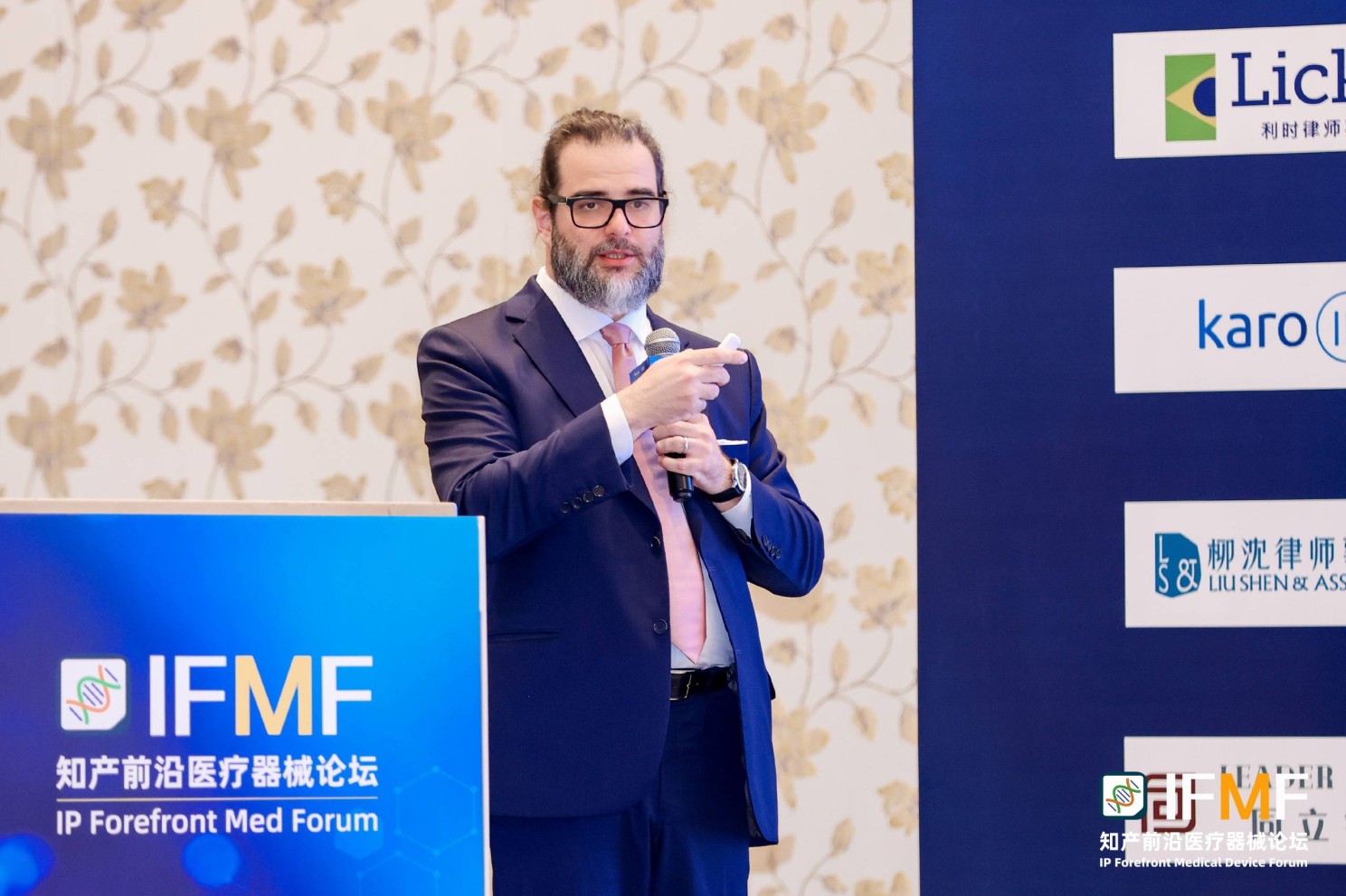
In Latin America, Brazil is the largest consumer market for medical devices and one of the countries most dependent on imports of medical equipment globally. As Sino-Brazilian economic and trade relations continue to heat up, Chinese medical device companies are paying increasing attention to the Brazilian market. However, how to effectively enter the market and protect their own innovations within a complex regulatory environment and patent system has become a core issue of concern to the industry. Eduardo Hallak , founding partner of Licks Attorneys in Brazil, gave a systematic exposition of the structural characteristics, regulatory framework, and patent protection system of the Brazilian medical device market based on his many years of practice experience, under the theme "Market Entry and Patent Portfolio Strategy in Brazil and the Wider Latin American Market." Eduardo Hallak began with Laozi's Tao Te Ching: "The highest good is like water. Water benefits all things and does not compete.," comparing innovation to flowing water—just as rivers in the painting A Thousand Li of Rivers and Mountains connect distant places, innovation can also connect faraway lands.
I. Overview of Sino-Brazilian Economic and Trade Relations and the Brazilian Medical Device Market
Eduardo Hallak pointed out that economic and trade ties between China and Brazil are becoming increasingly close. Since President Lula's first visit to China in 2004, Brazil-China trade has grown more than 22 times. China has been Brazil's largest trading partner since 2009, accounting for 24.2% of Brazil's total imports in 2024, up from 22.1% in 2023. China's share in Brazil's exports also rose from 26.8% in 2022 to 28% in 2024. In 2024, Brazil's total imports from China reached US$63.6 billion (US$53.1 billion in 2023), while Brazil's exports to China reached US$94.3 billion. In 2024, bilateral trade exceeded US$180 billion, accounting for nearly one-third of Brazil's total global trade.
In the medical device sector, Brazil is the largest hospital market in Latin America, with more than 6,700 hospitals and 211 million potential patients, and medical device consumption reached US$15.4 billion in 2024. Eduardo Hallak stressed that Brazilian medical device consumption is highly dependent on imports, with about 64.2% of equipment coming from overseas markets. In 2024, Brazil's total medical device imports reached US$9.79 billion, up 20.49% year-on-year. According to ABIMO (Brazilian Medical Device Industry Association) data, Brazil's medical device market reached US$18.7 billion in 2024, up 9.3% year-on-year, with imported equipment accounting for 62%. Brazil imported 119,066 tons of medical devices from China, with China ranking first in volume (one quarter of the market) and third in value (US$1.223 billion).
Eduardo Hallak specifically noted that there are two distinct markets in Brazil: the private sector and the public sector. The private supplementary health insurance market is the second largest in the world, second only to the United States, covering more than 50 million Brazilians (about 25% of the population). Equipment purchases are carried out by hospitals, clinics, and insurance operators through market-based negotiations, but must comply with ANVISA's quality and safety regulations. In the public sector, the Unified Health System (Sistema Único de Saúde,SUS) is a 100% government-funded universal free healthcare system that provides comprehensive medical services, including medical devices, to all Brazilian residents. Federal, state and local governments and public hospitals are all procurement entities, and procurement methods include electronic bidding (standard equipment, lowest price wins), competitive bidding (high-value or complex procurement), direct procurement (emergency or small-value cases), and the Price Registration System (SRP, centralized bidding for use by multiple public buyers). In addition, Product Development Partnerships (PDP) are also a strategic channel for foreign companies to enter Brazil's public market through technology transfer.
II. Brazil's Industrial Policy and Technology Cooperation Opportunities
Eduardo Hallak focused on the significance of the "New Industry Brazil" (NIB) strategy for the medical device industry. The plan was launched by the Brazilian federal government in January 2024 and aims to promote the comprehensive upgrading of national industry by 2033 through six strategic missions. Among them, the second mission—building a strong health-economic industrial complex—focuses on enhancing the domestic self-sufficiency capacity for medicines, vaccines, medical devices and other health products, with a target of increasing the localization rate from the current 45% to 50% by 2026, and ultimately reaching 70% by 2033. To achieve these goals, the Brazilian government plans to invest R$300 billion under the overall NIB framework (by 2026), of which about R$4.2 billion (approximately US$770 million) is specifically earmarked for medical devices and equipment, co-financed by public funds and the private sector. Health Minister Alexandre Padilha explicitly stated that enhancing local production capacity and reducing external dependence is a strategic choice for safeguarding national health sovereignty and supply chain security.
Eduardo Hallak particularly emphasized "Product Development Partnerships" (PDP) as a strategic channel for foreign companies to enter Brazil's public market. PDP is an important policy tool of Brazil's national public health system. Its core mechanism is to exchange public market procurement commitments for the transfer of advanced technology from multinational companies to local partners, thereby establishing a complete local production and manufacturing system in Brazil. Foreign companies establish cooperation with Brazilian public laboratories and enable local entities to master production capacity through technology transfer; during the technology transfer period of up to ten years, the government exclusively purchases the relevant products from the technology provider. Eduardo Hallak revealed that the Brazilian Ministry of Health, at a press conference in early July 2026, indicated that it plans to issue a new PDP public call in August, and interested parties can participate in this partnership program within the year.
In practice, the PDP model has attracted the participation of several Chinese companies. In September 2025, Gan & Lee Pharmaceuticals signed a supply framework agreement with a Brazilian local pharmaceutical company, with cumulative orders over ten years of no less than RMB 3 billion, becoming the first Chinese pharmaceutical company to participate in Brazil's PDP project. In November 2025, Sinovac signed two PDP projects with the Brazilian Ministry of Health, cooperating with local partners Tecpar Institute and Eurofarma to build a vaccine industry platform, providing approximately 60 million doses of varicella and rabies vaccines over the next 10 years, with a contract value exceeding US$700 million. These cases show that PDP has become an important institutional channel for deep cooperation in the medical and health field between China and Brazil.
III. ANVISA Regulatory Framework and Medical Device Classification
Eduardo Hallak pointed out that medical device regulation in Brazil is the responsibility of ANVISA (Brazilian National Health Surveillance Agency). ANVISA was established in 1999 (Law No. 9,782/1999) as an independent regulatory agency at the federal level. Despite some operational challenges, Brazil maintains a robust and continuously updated medical device regulatory environment, and its regulatory framework is constantly being aligned with international standards, particularly with the standards of IMDRF (International Medical Device Regulators Forum), of which Brazil is a member.
Under Resolution RDC 751/2022, issued on September 15, 2022 and effective from March 1, 2023, a medical device is defined as any instrument, apparatus, implant, in vitro diagnostic medical device, software, material, or other article intended by the manufacturer to be used for human beings, whose primary intended action is not achieved by pharmacological, immunological, or metabolic means. This resolution replaced RDC 185/2001, consolidating the notification and registration procedures for medical devices previously dispersed across multiple regulations, and adopted the IMDRF Technical
Documentation Table of Contents structure, so that documents prepared for other jurisdictions can also be used in Brazil.
Medical devices are classified into four classes according to health risk: Classes I and II are subject to the notification system, with no need for ANVISA technical analysis before marketing; Classes III and IV are subject to the registration system, requiring ANVISA technical analysis before marketing. According to Chambers' Healthcare: Medical Devices 2025 - Brazil guide, registrations for Class III and IV products are valid for 10 years and cover anesthesia kits, catheters, orthopedic fixation systems, hearing implants, and stents. In October 2025, ANVISA published a new edition of the "Registration Manual for Medical Devices and Software as a Medical Device," aiming to fully align with new regulations issued in recent years and provide clearer registration guidance to the industry. In addition, ANVISA's 2025 modernization plan has reduced the backlog in post-registration procedures for medical devices by 40%, while also advancing measures such as staff expansion, system upgrades, and review process optimization.
IV. Brazil's Patent System and Medical Device Patent Strategy
Eduardo Hallak shared patent data in the Brazilian medical device field. From January 2021 to June 19, 2026, among medical device-related patent applications in Brazil, human-use medical devices (examination, diagnosis, surgery, rehabilitation equipment, etc.) ranked at the top. In terms of applicant countries of origin, the United States ranked first, and China still has considerable room for growth.
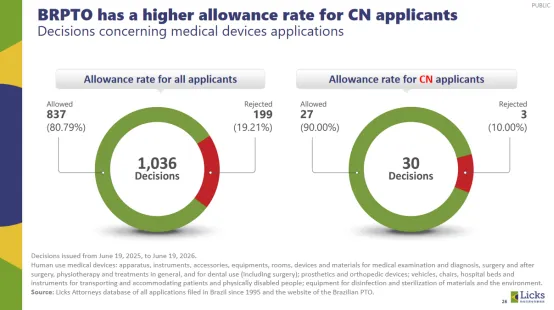
Eduardo Hallak particularly emphasized the grant rate advantage of Chinese applicants: in the field of human-use medical devices, Brazil's overall grant rate is about 80%, while Chinese applicants have a grant rate as high as 90%. Public statistics also show that Chinese applicants' overall grant rate in Brazil ranges from 87.99% to 91%, significantly higher than Brazil's overall average of about 77%.
Regarding examination timelines, Eduardo Hallak noted that Brazil's patent examination efficiency has greatly improved. In 2016, the average time from substantive examination request to decision was about 8 years, plus the requirement to file a substantive examination request within 3 years, totaling about 11 years. Currently, the average cycle has been shortened to 3.5 years. The fast-track examination channel can further shorten the period to about 10 months.
Regarding accelerated examination mechanisms, Eduardo Hallak introduced several paths. If the technology has already been commercialized in the Brazilian market, the product targets specific diseases (such as HIV, cancer, rare diseases), or there is infringement, priority examination can be requested. The PPH (Patent Prosecution Highway) provides an even faster channel—if the corresponding patent has been granted in a partner office and the Brazilian application has not yet entered substantive examination, PPH can be requested, and the examination cycle can be shortened to about 5 months. Effective January 1, 2025, Brazil's INPI also joined the Global Patent Prosecution Highway (GPPH) program. The China-Brazil PPH pilot project has continued to be extended from January 1, 2025. Since that date, INPI's total annual PPH application cap is 3,200 cases, with no more than 800 per quarter, and a cap of 1,000 per IPC section per year.
Regarding patentability, Eduardo Hallak reminded of the limitation under Article 10, item 8 of the Brazilian Patent Law: surgical techniques, therapeutic methods, or diagnostic methods directly applied to the human or animal body are not patentable. For example, cardiac catheterization methods or coronary stent implantation methods are not patentable, but the relevant kits and devices can be protected. Diagnostic methods performed on biological samples (such as blood samples) are patentable.
With respect to claim drafting, Eduardo Hallak emphasized that Brazil adopts a two-part format, using a "characterized by" clause to distinguish prior art from novel technical features; dependent claims may reference multiple claims, but must be in the alternative or additional form, and technical features must be accompanied by reference numerals in parentheses corresponding to the drawing numbers.
V. Brazil's Bifurcated Patent Litigation System and Enforcement Practice
Eduardo Hallak explained in detail Brazil's "bifurcated" patent litigation system, which is similar to Germany's but differs from China (where patent infringement and invalidity are both heard by intellectual property courts or civil courts). In Brazil, infringement actions are heard by state courts, while invalidity actions are heard by federal courts. This division stems from the Brazilian Constitution, which provides that disputes involving federal entities (including BRPTO) are under federal court jurisdiction.
Under the bifurcated system, infringement and invalidity actions are heard separately by different courts, even if they involve the same patent and the same technical dispute. State courts, when hearing infringement cases, presume the patent valid and can issue infringement rulings and preliminary injunctions promptly. Federal courts independently hear invalidity disputes. Eduardo Hallak emphasized that patent enforcement in Brazil is highly effective. Preliminary injunctions (including ex parte injunctions) can be obtained within weeks, and the preliminary injunction approval rate at the Rio de Janeiro Commercial Court is as high as 85%. Injunctive relief includes daily fines, warehouse search and seizure, issuance of "exclusion orders" to customs (detaining imported goods), and sending letters to partners and distributors to cut off supply chains. In terms of border measures, courts can notify Brazilian customs to detain infringing imported goods.
Eduardo Hallak shared data showing that the validity of Brazilian patents is extremely robust—among 437 patent invalidity actions filed nationwide over the past 10 years, the vast majority of patents were maintained.
Eduardo Hallak concluded by saying that innovation is like water and needs a solid riverbed to flow ceaselessly—the institutional foundation jointly built by China and Brazil over many years provides strong protection for innovative cooperation in the medical device field. From Laozi's Eastern philosophy of "the highest good is like water," to the magnificent landscape of a thousand miles of rivers and mountains in Wang Ximeng's brushwork, to the economic exchanges and technological integration between China and Brazil across mountains and seas, this great river formed by innovation surges forward through the multiple channels of institutions, markets, and law.

*Note: All content herein is shared solely for communication purposes and reflects my personal views at the time of discussion. It does not represent a fixed position nor does it involve or reflect the official stance or position of any company or organization.
This article was initially published on the IP Forefront WeChat Official Account on 16 July 2026

RECENT PUBLICATIONS
-

Brazilian Court-appointed expert reports demonstrate SEP owners’ FRAND compliance: Comparable licenses can lead to evidence-based preliminary injunctions
October 05, 2026 -

Licks Advogados realiza evento com John Cioffi, o pai do DSL
October 01, 2026 -

Licks Attorneys | Patent Prosecution Made Simpler, Faster, and More Efficient
September 30, 2026
LINKEDIN FEED

FOLLOW US ON SOCIAL MEDIA