Newsletter

Register your email and receive our updates

Thank you! Your submission has been received!
Oops! Something went wrong while submitting the form.

FOLLOW US ON SOCIAL MEDIA

The Railway Statute in Brazil

January 5, 2026

The Brazilian railway sector, historically challenged by inadequate infrastructure, bureaucratic hurdles, and an overreliance on road freight transport, has long needed a regulatory framework to unlock its true potential. Statute #14,273 of December 23, 2021, governing rail transport, represents a watershed moment. Known as the “New Railway Statute,” it emerged from extensive debate in the National Congress with a promise to modernize the sector's legal foundations, attract substantial private investment, and spur the development and expansion of the national rail network.

SEE MORE

The European Commission's adequacy decision for Brazil

January 2, 2026

The protection of personal data has become a central issue in the global legal and technological landscape. With the increasing digitalization of the economy and the cross-border flow of data, harmonizing legislation and recognizing equivalent levels of data protection between countries are fundamental steps to ensure legal certainty and the smooth operation of international commerce. The European Union's recent decision to recognize Brazil as a country with a level of personal data protection “essentially equivalent” to its own represents a significant milestone in this regard.

SEE MORE

Regulation of artificial intelligence in law

November 26, 2025

Artificial intelligence (AI) represents one of the most profound technological revolutions in recent history, with the potential to redefine society, the economy, and human interactions. Its ability to process large volumes of data, identify complex patterns, and perform tasks once exclusive to the human mind has generated transformative impacts across multiple sectors. From medicine, with more accurate diagnoses, to industry, with process optimization, AI is reshaping the way we live and work. At the epicenter of this transformation, the legal sector stands out as a particularly fertile ground for AI applications and, consequently, for AI regulation.

SEE MORE

European Union decision reignites debate over illegal content on social media

October 28, 2025

Last Friday, October 24, The Guardian published an article alleging that Meta Platforms Inc. had violated European Union (EU) law. The story was significant not only because it involved one of the world's largest companies, which controls giants like Facebook, Instagram, and WhatsApp, but also because it reignited the debate over social networks' responsibility to control illegal content on their platforms.

SEE MORE

New regulations for clinical research in Brazil

October 15, 2025

Clinical research is the backbone of medical and scientific progress. It supports the development of new treatments, medicines, and devices that save and improve lives. Science advances through rigorous studies, offering hope and solutions for countless health conditions.

SEE MORE

What about the FCPA?

October 13, 2025

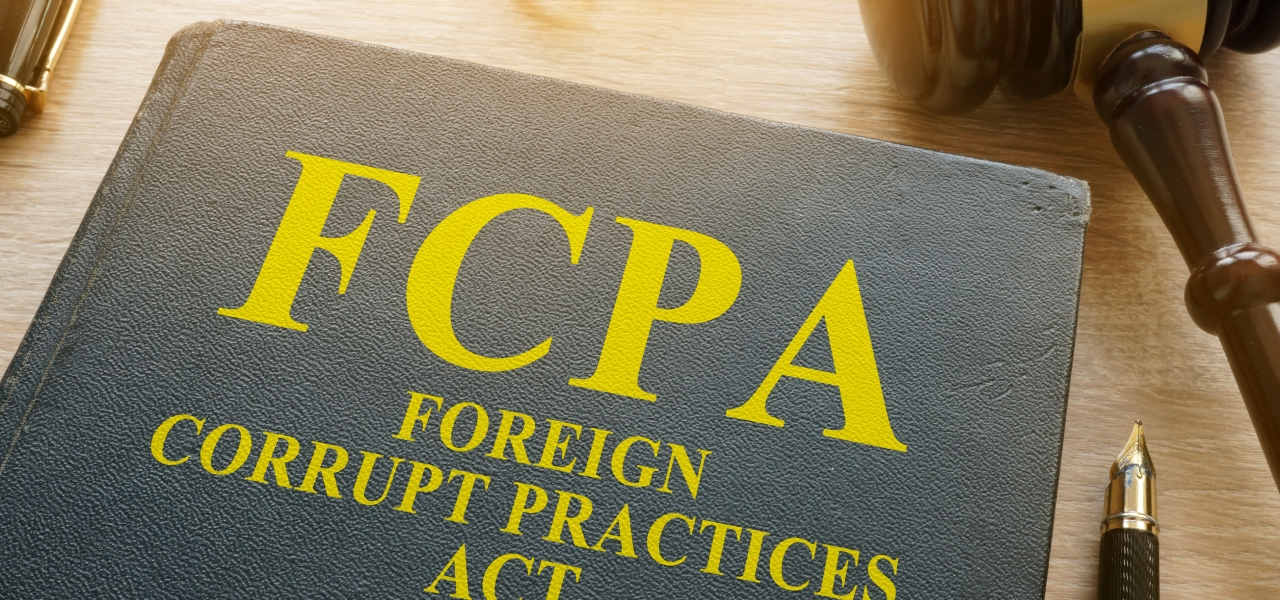
The Foreign Corrupt Practices Act (FCPA) of the United States was a legislative milestone in the global fight against corruption. Since its enactment, this law has been a powerful tool for promoting business ethics and ensuring transparency in international operations. It has also served as an inspiration for local regulations in other countries, which seek to purge the ills of corruption – a problem that plagues nations equally, regardless of their level of development or size.

SEE MORE

MENAC and the dismantling of corruption in Portugal

September 29, 2025

In Portugal, the fight against corruption has become a growing concern and a fundamental pillar for consolidating trust in democratic institutions, significantly contributing to a more transparent and fair business environment. Corruption, in its various forms, erodes society, diverts public resources essential for development, and damages the country's international reputation. Aware of these challenges, Portugal has sought to strengthen its legal and institutional framework to prevent, identify, and effectively suppress this scourge.

SEE MORE

New CGU regulations for compliance programs in public tendering

September 24, 2025

The public tendering landscape in Brazil has long been a subject of debate concerning efficiency and transparency, as well as, unfortunately, the persistence of corrupt practices. The relentless pursuit of a more honest, competitive, and ethical environment has culminated in a significant regulatory shift in recent years, driven by Law #14,133/2021, the New Tendering and Administrative Contracts Act. This legislation, which replaced the previous Law #8,666/93, Law #10,520/2002, and Law #12,462/2011, introduced a series of innovations. A key innovation is the formal requirement and incentive for the implementation and maintenance of integrity and compliance programs by companies wishing to contract with the federal government.

SEE MORE

Regulation of artificial intelligence in Brazil and worldwide

September 17, 2025

Regulations on Artificial Intelligence (AI) are developing rapidly around the world, reflecting growing concerns about the technology's ethical, social, economic, and security impacts. Different regions have adopted distinct approaches, influenced by their cultural, political, and economic priorities, in an effort to balance innovation with public protection.

SEE MORE

China's Personal Information Protection Law

September 9, 2025

The Personal Information Protection Law (PIPL) of the People's Republic of China, which came into effect on November 1, 2021, represents a significant milestone in the global data privacy landscape. Considered China's most comprehensive data privacy legislation to date, the PIPL establishes a stringent set of rules for the processing of personal information. It aligns with global standards like the European Union's General Data Protection Regulation (GDPR) but incorporates characteristics and nuances specific to the Chinese context, reflecting the fundamental pillars of cyber sovereignty and national security.

SEE MORE

ABOUT US

Licks Attorneys Compliance’s Blog provides regular and insightful updates about Ethic and Compliance. The posts are authored by Alexandre Dalmasso, our partner. Licks Attorneys is a top tier Brazilian law firm, specialized in Intellectual Property and recognized for its success handling large and strategic projects in the country.

LINKEDIN FEED

Newsletter

Register your email and receive our updates -

Thank you! Your submission has been received!
Oops! Something went wrong while submitting the form.

FOLLOW US ON SOCIAL MEDIA

Licks Attorneys' COMPLIANCE Blog

The Railway Statute in Brazil

The Brazilian railway sector, historically challenged by inadequate infrastructure, bureaucratic hurdles, and an overreliance on road freight transport, has long needed a regulatory framework to unlock its true potential. Statute #14,273 of December 23, 2021, governing rail transport, represents a watershed moment. Known as the “New Railway Statute,” it emerged from extensive debate in the National Congress with a promise to modernize the sector's legal foundations, attract substantial private investment, and spur the development and expansion of the national rail network.

The Railway Statute in BrazilRead Full Article

The European Commission's adequacy decision for Brazil

The protection of personal data has become a central issue in the global legal and technological landscape. With the increasing digitalization of the economy and the cross-border flow of data, harmonizing legislation and recognizing equivalent levels of data protection between countries are fundamental steps to ensure legal certainty and the smooth operation of international commerce. The European Union's recent decision to recognize Brazil as a country with a level of personal data protection “essentially equivalent” to its own represents a significant milestone in this regard.

The European Commission's adequacy decision for BrazilRead Full Article

Regulation of artificial intelligence in law

Artificial intelligence (AI) represents one of the most profound technological revolutions in recent history, with the potential to redefine society, the economy, and human interactions. Its ability to process large volumes of data, identify complex patterns, and perform tasks once exclusive to the human mind has generated transformative impacts across multiple sectors. From medicine, with more accurate diagnoses, to industry, with process optimization, AI is reshaping the way we live and work. At the epicenter of this transformation, the legal sector stands out as a particularly fertile ground for AI applications and, consequently, for AI regulation.

Regulation of artificial intelligence in lawRead Full Article

European Union decision reignites debate over illegal content on social media

Last Friday, October 24, The Guardian published an article alleging that Meta Platforms Inc. had violated European Union (EU) law. The story was significant not only because it involved one of the world's largest companies, which controls giants like Facebook, Instagram, and WhatsApp, but also because it reignited the debate over social networks' responsibility to control illegal content on their platforms.

European Union decision reignites debate over illegal content on social mediaRead Full Article

Regulation of artificial intelligence in Brazil and worldwide

Regulations on Artificial Intelligence (AI) are developing rapidly around the world, reflecting growing concerns about the technology's ethical, social, economic, and security impacts. Different regions have adopted distinct approaches, influenced by their cultural, political, and economic priorities, in an effort to balance innovation with public protection.

Regulation of artificial intelligence in Brazil and worldwideRead Full Article

Brazil’s Superior Court of Justice ratifies joint and several liability in Brazilian Anti-Corruption Act

The Brazilian Anti-Corruption Act (Law #12,846/2013) represents a fundamental milestone in Brazil's fight against corruption by establishing, among other provisions, the objective liability of legal entities for acts harmful to the public administration.

Brazil’s Superior Court of Justice ratifies joint and several liability in Brazilian Anti-Corruption ActRead Full Article

The Uruguayan Dignified Death Act

As reported by Veja magazine, the Uruguayan House of Representatives approved the Dignified Death Act on August 13, 2025, by a vote of 64 to 29, paving the way to legalize euthanasia in the country. The bill will now proceed to a vote in the Senate before it can take legal effect.

The Uruguayan Dignified Death ActRead Full Article

Understanding the National Security and Investment Act

The global technological and geopolitical landscape has been rapidly evolving, highlighting a growing concern among nation states about protecting their strategic interests and economic sovereignty. Given this accelerating technological advancement and the critical importance of certain sectors to countries’ sustained growth, the United Kingdom – an open economy reliant on foreign investment – is no exception.

Understanding the National Security and Investment ActRead Full Article

SEC has record financial penalty collection in 2024

The US Securities & Exchange Commission (SEC) announced in early December, according to The Wall Street Journal, record-breaking year for financial penalty collections in 2024.

SEC has record financial penalty collection in 2024Read Full Article

Australia to ban minors from accessing social media

One of the biggest concerns for parents in the modern world is their children's use of social media. Depending on how they are used, social media can become a huge headache for parents and their children tend to be the most vulnerable part in this unfiltered environment, where a world of discoveries is just a click away.

Australia to ban minors from accessing social mediaRead Full Article

Do you know what the No Surprises Act is? Understanding its importance

The No Surprises Act is a prime example of legislation in a country where the legal system is based more on case law than statutes. While Brazil’s legal system originates from Civil Law, the United States follows Common Law. However, U.S. laws are often very well-drafted, especially in terms of their applicability. In this context, it is important to consider the role of the judiciary, which operates under the punitive principle, unlike Brazil's compensatory system, which is less effective.

Do you know what the No Surprises Act is? Understanding its importanceRead Full Article

SEC Combats Corporate Retaliation Against Whistleblowers

Since the Dodd-Frank Act was enacted in the United States in 2010, the role of whistleblowers has proven crucial in helping authorities prevent fraud, bribery, and other legal violations. This is because the government lacks the personnel and resources to efficiently monitor the market on its own.

SEC Combats Corporate Retaliation Against WhistleblowersRead Full Article

The Brazilian Medical Association Intervenes in the Relationship between Physicians and the Pharmaceutical and Medical Products Industry

A significant concern in the healthcare sector is the potential conflict of interest between the pharmaceutical and medical products industry and healthcare professionals, particularly physicians. This potential conflict arises from the unique nature of the relationship: while the industry’s end customer is the patient, it is the physician who decides which product the patient will use. At the same time, patients pay physicians to prescribe the best treatment for their well-being.

The Brazilian Medical Association Intervenes in the Relationship between Physicians and the Pharmaceutical and Medical Products IndustryRead Full Article

A Decision by the Brazilian Superior Court of Justice Sets Precedent in the Advertising of Medicines

The First Panel of the Brazilian Superior Court of Justice unanimously decided, under the report of Justice Regina Helena Costa, in the appellate decision on Special Appeal #2035645/DF, that Anvisa (the Brazilian FDA) does not have the regulatory authority to restrict the commercial advertising of pharmaceuticals by companies. This applies especially when its regulatory actions contradict the provisions established in Law #9,294/1996 and other legislative acts.

A Decision by the Brazilian Superior Court of Justice Sets Precedent in the Advertising of MedicinesRead Full Article

The "Emprega + Mulheres" Program and the Impact on Employment Relationships

It is well-known that certain market sectors impose additional barriers when hiring women. This is often due to concerns that, during pregnancy, employees may need to take time off for childbirth, utilizing maternity leave. Complications during pregnancy can also arise, potentially weakening the workforce and prompting companies to hire temporary workers to cover the absence.

The "Emprega + Mulheres" Program and the Impact on Employment RelationshipsRead Full Article